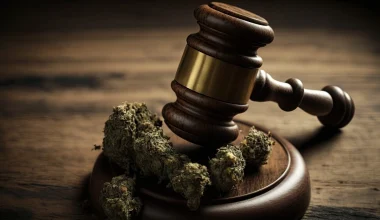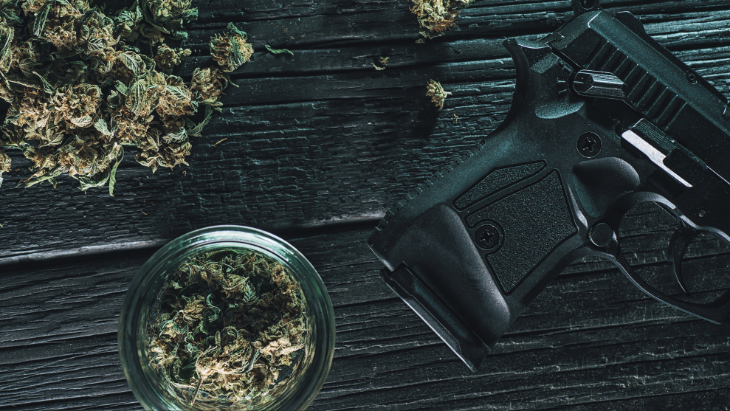
Supreme Court justices heard oral arguments today for and against the imposition of a longstanding federal law categorically disarming those with a history of cannabis use.
Lawyers for the Justice Department are appealing the 5th Circuit Court of Appeals decision (United States v. Hemani) which determined the 2nd Amendment ban to be unconstitutional. Other lower courts have offered similar opinions.
They argued that the federal government has an interest in ensuring that those who habitually consume illicit drugs do not possess firearms because Schedule I substances, including cannabis, have been determined by Congress to be dangerous per se. Therefore, even if one uses it only “a couple of time a week, [they] should be disarmed,” they argued.
Several justices appeared to be skeptical of the government’s position, opining that the degree to which a substance may or may not induce a consumer toward violence is not a specific criterion of the Controlled Substances Act. Justices also questioned the reliability of the federal government’s assessment of cannabis as a Schedule I drug, especially after the White House recently directed the US Attorney General to reclassify it to Schedule III, and asked if there is any convincing historical evidence connecting cannabis to violence.
NORML was among several advocacy organizations, including the National Rifle Association, that filed amicus briefs in the case asking the Court to strike down the categorical ban.
“For centuries, Americans cultivated, consumed, and prescribed cannabis without any suggestion that doing so warranted loss of firearms rights. And state-legal medical cannabis users readily continue to do so today with the protection of Congress,” NORML’s brief explains. “The historical analogs the government identifies concern temporary restrictions on carrying or firing weapons while intoxicated or on persons adjudged dangerous — not blanket bans on all users of a disfavored substance.”
Speaking to CNN, NORML’s Board Chair Joseph A. Bondy – who co-authored NORML’s brief – said that cannabis, unlike alcohol, is not typically associated with inducing violent behavior. He further added that cannabis is consumed responsibly by “millions and millions” of Americans and that the federal government’s efforts to “disarm an entire class of people” clearly violates Constitutional protections.
Following today’s oral arguments, he said: “Based on the questions presented, I believe a majority of the Court recognizes that the government may not categorically disarm responsible adults solely because they use cannabis, absent any showing of habitual use and dangerousness. The Second Amendment protects individuals, not status-based classifications, and the historical tradition the Court requires does not support such a blanket prohibition.“
For decades, the federal government has asserted that the 1968 prohibition on firearm possession by “unlawful users” of federally controlled substances should be applied broadly, effectively criminalizing gun ownership based upon any past marijuana use — even absent intoxication or dangerous conduct. In practice, the ban has been used by government agencies to prohibit firearm ownership for people without a history of chronic or problematic use. According to the Bureau of Alcohol, Tobacco, Firearms, and Explosives, in Fiscal Year 2025, nearly half of those denied firearms under the ban were disapproved based upon a single past incident of drug use.
A decision by the Court is expected this summer.
A copy of this and other related NORML briefs can be found in NORML’s Legal Brief Bank.
Related
Medical Disclaimer:
The information provided in these blog posts is intended for general informational and educational purposes only. It is not a substitute for professional medical advice, diagnosis, or treatment. Always seek the advice of your physician or other qualified healthcare provider with any questions you may have regarding a medical condition. The use of any information provided in these blog posts is solely at your own risk. The authors and the website do not recommend or endorse any specific products, treatments, or procedures mentioned. Reliance on any information in these blog posts is solely at your own discretion.