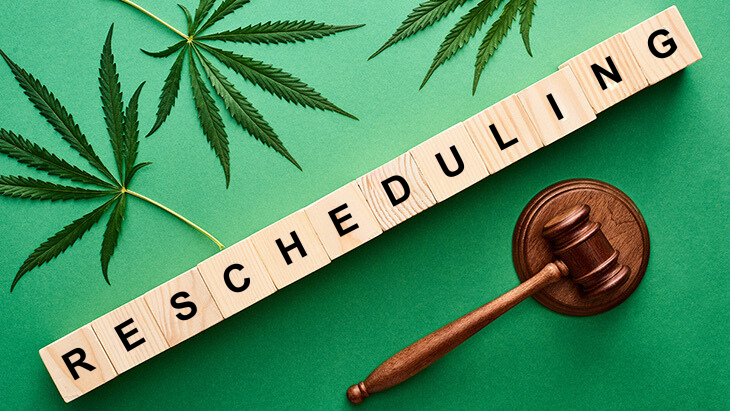

Several media outlets have reported that President Donald Trump intends to direct his administration to amend marijuana’s longstanding classification as a Schedule I federally controlled substance without accepted medical value. That’s according to new reporting by The Washington Post, which cites multiple sources with direct knowledge of the situation. Other news outlets, including Forbes, Axios, and Bloomberg News, have also reported the story, though spokespersons for the White House insist that “no final decisions” have yet to be made on the matter.
President Trump previously announced at a news conference in August that his administration was “looking” at federally reclassifying cannabis and that it would “make a determination over the next few weeks.” In a Truth Social post last year, Trump wrote, “As President, we will continue to focus on research to unlock the medical uses of marijuana to a Schedule 3 drug, and work with Congress to pass common sense laws, including SAFE banking for state authorized companies, and supporting states’ rights to pass marijuana laws.”
If the White House ultimately moves forward with the proposed rescheduling directive, it will be consistent with a 2023 recommendation from the US Department of Health and Human Services calling for the substance to be recategorized federally as a Schedule III controlled substance. The Department reviewed the safety and therapeutic efficacy of cannabis following a 2022 order from the Biden Administration to reconsider cannabis’ Schedule I status under federal law.
NORML’s Deputy Director Paul Armentano said: “Removing cannabis from its Schedule I classification validates the experiences of tens of millions of Americans, as well as those of tens of thousands of physicians, who have long recognized that cannabis possesses legitimate medical utility. But while such a move potentially provides some benefits to patients, and veterans especially, it still falls well short of the changes necessary to bring federal marijuana policy into the 21st century.
“Specifically, rescheduling fails to harmonize federal marijuana policy with the cannabis laws of most states, particularly the 24 states that have legalized its use and sale to adults — thereby leaving those who produce, dispense, possess, or use marijuana in compliance with state laws in jeopardy of federal prosecution. In order to rectify this state/federal conflict, and in order to provide state governments with the explicit authority to establish their own cannabis regulatory policies — like they already possess with respect to alcohol — cannabis must be removed from the Controlled Substances Act altogether. Doing so would affirm America’s longstanding principles of federalism and appeal to Americans’ deep-rooted desires to be free from undue government intrusion into their daily lives.”
Although the President cannot unilaterally reclassify marijuana, he can direct requisite agencies, like the Office of the US Attorney General, to take steps necessary to reclassify the substance. Following the publication of the formal rule change in the Federal Register, interested parties have a window of opportunity to challenge the order legally, which could further delay the process. If there is no legal challenge, the change typically takes effect within 30 days.
Since 1970, cannabis has been classified federally as a Schedule I controlled substance, meaning it possesses a “high potential for abuse” and “no currently accepted medical use.”
Additional information on rescheduling and its implications for state and federal marijuana policies is available from NORML’s factsheet, ‘Cannabis Rescheduling: Myths Versus Reality.’
Related
Medical Disclaimer:
The information provided in these blog posts is intended for general informational and educational purposes only. It is not a substitute for professional medical advice, diagnosis, or treatment. Always seek the advice of your physician or other qualified healthcare provider with any questions you may have regarding a medical condition. The use of any information provided in these blog posts is solely at your own risk. The authors and the website do not recommend or endorse any specific products, treatments, or procedures mentioned. Reliance on any information in these blog posts is solely at your own discretion.