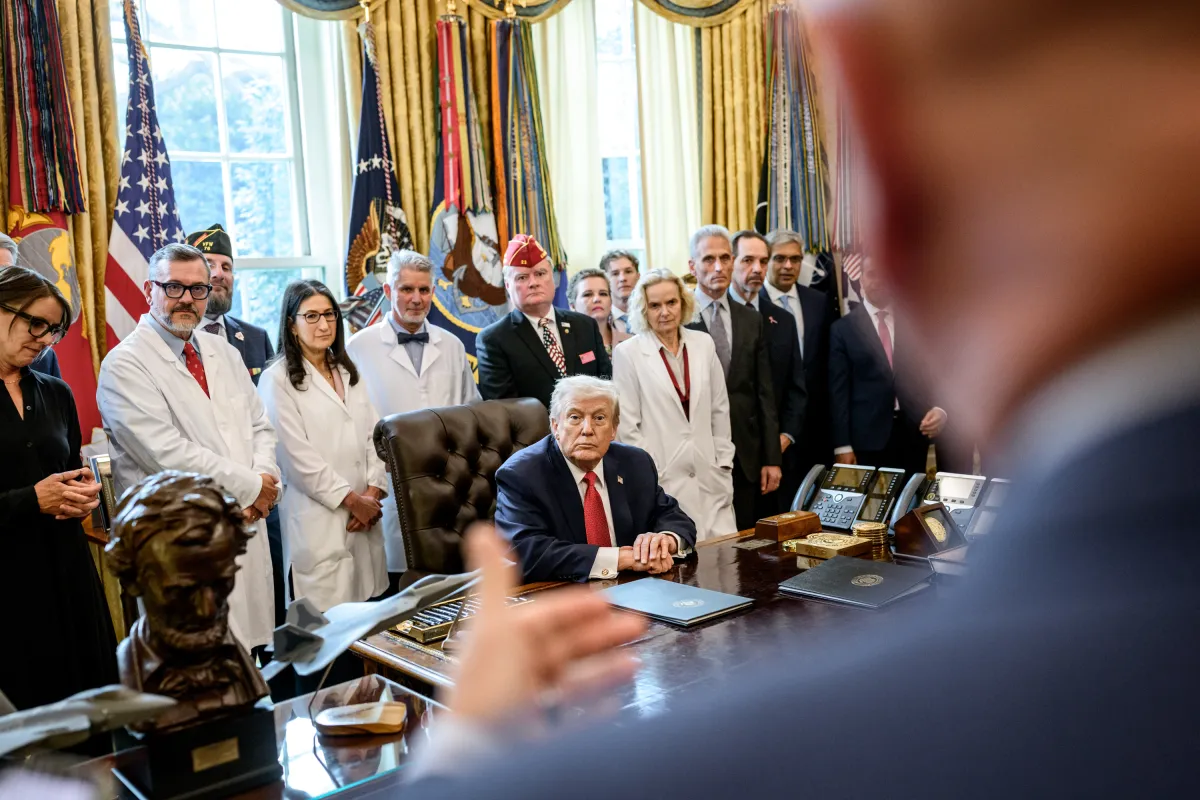
President Donald Trump’s Dec. 18 executive order directing the Justice Department to officially classify cannabis as a less-dangerous drug with medicinal value under federal law is historic and transformative.
But marijuana rescheduling is also generating confusion, wild speculation and genuine misinformation in and around the $32 billion U.S. regulated cannabis industry.
On top of the practical questions, such as what exactly this does and when it happens, some wild theories and strange conjecture abound, including allegations this is all a looming Big Pharma takeover (not anytime soon) and that this means cannabis companies can claim federal tax relief going back years (don’t push your luck).
MJBizDaily participated in a webinar with Denver-based law firm Vicente LLP on Dec. 22 addressing these and a few other urgent issues. Some are points of law that will be argued (and re-argued) in court. Other question marks hinge on future action. But there are some known knowns.

Here are some of the industry’s most pressing and most-asked questions around marijuana rescheduling.
When is cannabis officially Schedule 3?
Unclear, but soon, or soonish – probably. Unless someone screws something up, and then it could be years.
On Dec. 18, Trump directed Attorney General Pam Bondi to “take all necessary steps to complete the rulemaking process related to rescheduling marijuana to Schedule III,” and to do so “in the most expeditious manner in accordance with Federal law.” How fast is “the most expeditious”? No one knows – maybe not even the White House. “There is no deadline,” Shane Pennington, a partner with national law firm Blank Rome, recently told MJBizDaily.
In theory, the Justice Department could move quickly, declare the currently paused process left over from the Biden administration finished and publish a final rule in the Federal Register, the official record of what the federal government does – after which time final rules are usually effective in 30 days.
But there are complications. Critics dragged the Biden administration rescheduling process for taking too long, in part because the DOJ adhered to the process: taking public comment, responding to some of them, scheduling hearings before an administrative law judge – that is, building a record should the question come up in court of whether federal law was followed.
Legalization opponents have vowed to sue to stop rescheduling no matter what. If corners are cut and cannabis foes can convince a federal judge that the process wasn’t right, rescheduling could end up stuck in the courts. And United States court is rarely an expeditious process.
Does marijuana rescheduling mean 280E no longer applies in 2025? Is 280E relief retroactive?
For many operators, the top question relates to tax relief, how much of it and when. “Everybody’s super excited about not having to deal with 280E,” said Rachel Gillette, a Denver-based partner at Holland & Hart, in the understatement of the year.
But some operators appear to be ready to file their 2025 returns free from 280E or go even further and file amended returns going back years. They are certainly free to do so, but that seems to guarantee a fight with the Internal Revenue Service in tax court – which is probably where the issue was destined, anyway.
Keep in mind cannabis remains Schedule 1 until the above process plays out – that is, until sometime in 2026 at the earliest. That means cannabis was Schedule 1 for all of 2025 – which means 280E applies.
As some tax experts recently noted in Bloomberg Law, the Internal Revenue Service has generally never allowed retroactive amendments to prior year returns based on changes in the law. (Think about it this way: marijuana legalization has allowed certain past offenses expunged but only because of accompanying changes in the law allowing for expungements; Congress could in theory also allow past 280E bills wiped out, but seems unlikely to do so.)
“That’s the official position of the IRS,” Gillette noted.
However, that doesn’t mean some enterprising cannabis operators won’t push the issue anyway and file amended returns for past years and/or 2025 returns claiming immunity. But that means spoiling for a fight.
“Everything can be argued by a lawyer,” Gillette noted.
What does this mean for the hemp THC ban?
Very little, at least directly.
Thanks to the spending bill Trump signed into law last month to end the record-long government shutdown, the federal definition of hemp will change in November 2026. When it does, nearly all of the products keeping the $28.3 billion U.S. hemp sector afloat become illegal – at least under federal law. Many states still have hemp regulations that remain unchanged regardless of what the feds do – and exactly what they can do, if they do anything at all, is far from clear.
(If that sounds familiar, it should: That’s the status quo for state-regulated cannabis.)
Nothing in Trump’s executive order changes this, either on the state or the federal level. However, the order does direct top White House officials to “work with the Congress to update the statutory definition of final hemp-derived cannabinoid products to allow Americans to benefit from access to appropriate full-spectrum CBD products while preserving the Congress’s intent to restrict the sale of products that pose serious health risks.”
Keep in mind that Mehmet Oz, the director of the Centers for Medicaid Services, promised that senior citizens in the U.S. could see up to $500 in annual reimbursements for CBD products by April. It will be hard for them to have any products to reimburse if they can’t get anything – and the hemp industry has said that the limit, set to go into effect next year, of no more than 0.4 milligrams of THC per container of finished product is unworkable.
Trump’s EO puts the executive and legislative branches on notice to revisit the hemp question. Presidential encouragement is likely to encourage action, but it does not guarantee it.
For hemp-derived THC beverages to enjoy federal protections or for full-spectrum CBD products to stay on the market, Congress must act.
What else does this mean for existing cannabis businesses?
For now, that’s pretty much it.
It’s true that other Schedule 3 drugs, like Tylenol with codeine and anabolic steroids, are legally obtained only via prescription and only from valid pharmacies via the U.S. Food and Drug Administration approval process. It’s also true that botanical products, like cannabis flower, aren’t generally sold in pharmacies with a doctor’s note.
Few serious cannabis industry observers will tell you that the existing state-regulated dispensary/retail model is suddenly going to end or that cannabis somehow becomes more illegal when restrictions are relaxed. (That’s the whole point of relaxing restrictions – and cannabis was already Schedule 1, the strictest control available, and the feds didn’t shut it all down.)
More changes to federal law are almost certainly coming. Some could come as soon as 2026. But rescheduling isn’t meant to disrupt the existing industry, and by itself should not.
Chris Roberts can be reached at chris.roberts@mjbizdaily.com.
Medical Disclaimer:
The information provided in these blog posts is intended for general informational and educational purposes only. It is not a substitute for professional medical advice, diagnosis, or treatment. Always seek the advice of your physician or other qualified healthcare provider with any questions you may have regarding a medical condition. The use of any information provided in these blog posts is solely at your own risk. The authors and the website do not recommend or endorse any specific products, treatments, or procedures mentioned. Reliance on any information in these blog posts is solely at your own discretion.