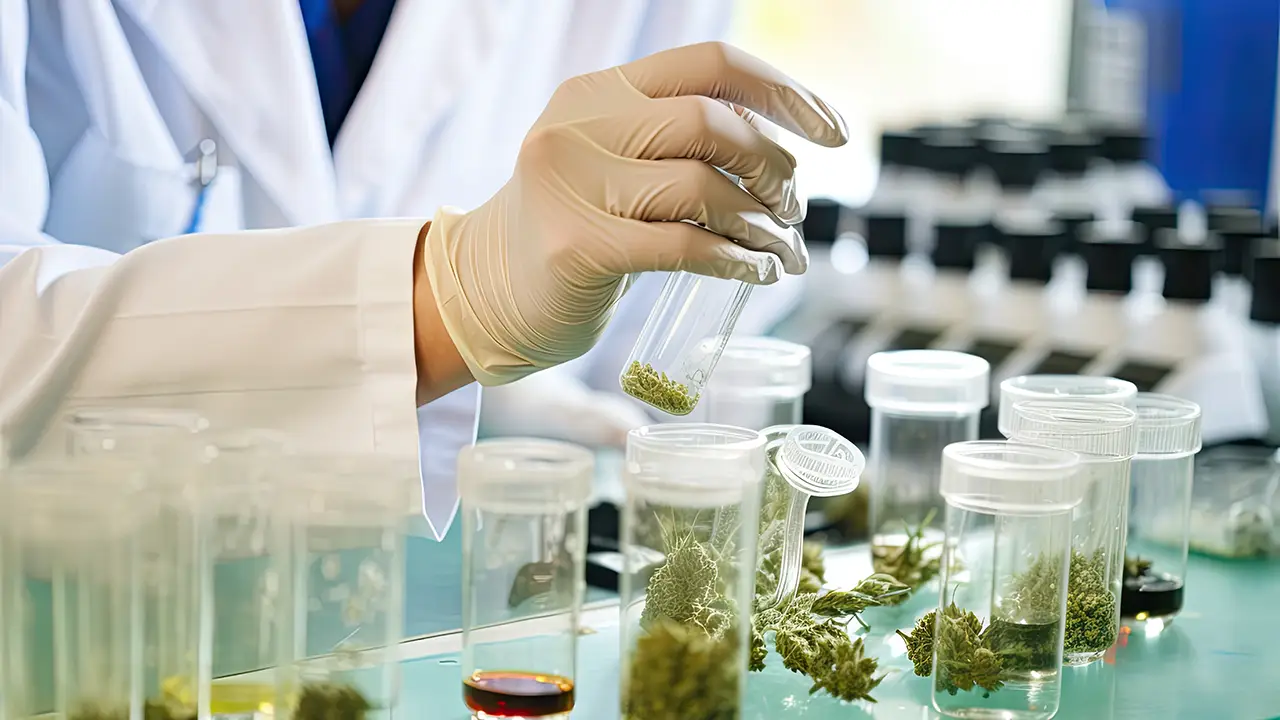
Kim Rivers runs a company that deals primarily in medical cannabis. Following President Donald Trump’s Dec. 18 move to relax federal restrictions on the drug, Rivers’ Florida-headquartered Trulieve Cannabis Corp. wants to bring a marijuana-based medicine to market – specifically, a “time-release product” intended for sufferers of Parkinson’s disease.
Great leaps forward in medicine and science are expected when marijuana is officially Schedule 3. But classifying cannabis with drugs like anabolic steroids and Tylenol with codeine has another profound benefit. Only with cannabis research will advocates get what they want and see cannabis descheduled – and then, eventually, legalized nationally, business leaders and advocates say.
“Everybody talks about Schedule 3 from a tax perspective,” said Boris Jordan, the chairman and founder of competing marijuana multistate operator Curaleaf Holdings, referring to Internal Revenue Code Section 280E, which applies to Schedule 1 and 2 drugs and forbids basic business deductions on federal returns.
“And sure, that’s nice,” Jordan told MJBizDaily. But “the most important thing” is being able to show, with data and clinical research, “what parts of the plant are harmful, if any, and what forms of consumption of that plant are harmful, if any,” he added.

“Only then will that industry get legalized on a national basis in the U.S.”
Trump marijuana rescheduling will disrupt decades of stymied research
For decades, American researchers curious about what cannabis does have had two options, neither ideal: Rely on survey-based anecdotal accounts from users, or jump through hoops to obtain “research-grade” cannabis that bears little resemblance to the products sold on dispensary and retail shelves in nearly 40 states.
It was that “survey-based” data, much of it provided by states with medical cannabis programs, that led the Department of Health and Human Services to declare in August 2023 that cannabis has a “currently accepted medical use” in the United States.
Both the Biden-era proposed rule to reclassify cannabis as Schedule 3 as well as Trump’s Dec. 18 executive order relied on that key finding. That’s only the start. From here, researchers will be able to say with confidence what high-THC vaporizers, functional THC blends and other products do.
“Now we can go and actually do meaningful clinical trial-type research using actual marijuana products that Americans are using,” Rivers told former Florida Republican Rep. Matt Gaetz during an interview on far-right One America News Network (OANN).
But cannabis companies still have a way to go before they can compete with Big Pharma – if that’s even the intent.
Can the cannabis industry compete with Big Pharma?
Absent major government intervention in the way of funding and other resources, developing U.S. Food and Drug Administration (FDA)-approved treatments in the United States is a costly and time-consuming process.
Rescheduling should make it easier for researchers to study cannabis-based medicines – and, with the 280E savings, find the money to pay for it.
Cautious institutions reliant on federal funding like universities and hospitals won’t be so worried about touching marijuana. With federal tax reform, cannabis companies will have more money to fund science, in the form of extra profits as well as extra investor dollars.
And right away, though details are still scant, Trump’s order announced a cannabis research effort.
The executive order instructs Health Secretary Robert F. Kennedy Jr., FDA Commissioner Marty Makary and Mehmet Oz, administrator of the Center for Medicare & Medicaid Services to “develop research methods and models utilizing real-world evidence to improve access to hemp-derived cannabinoid products.”
However, there are complications.
Cannabis research red tape still there thanks to Biden-era bill
As some anti-cannabis organizations have been trumpeting, a Biden administration-era research bill imposes cannabis-specific research limitations that apply regardless of rescheduling.
That’s one reason the Medical Marijuana and Cannabidiol Research Expansion Act, coauthored by U.S. Rep. Andy Harris, a Maryland Republican and one of the key advocates of the looming ban on hemp-derived THC and signed into law by former President Joe Biden in late 2022, appears to have done little in the nearly three years since its passage.
However, neither researchers nor lawyers familiar with the problem expect that law to work as some of its supporters intended and hold cannabis science back.
“The Biden-era research law was designed to create a clearer pathway for cannabis studies, but its impact has been limited because the requirements remain tied to Schedule 3 rules,” said Chad Johnson, an assistant professor of pharmaceutical sciences and director of the Graduate Studies in Medical Cannabis Science and Therapeutics Program at the University of Maryland School of Pharmacy.
“Rescheduling to Schedule 3 won’t automatically change those provisions, but it will reduce stigma and encourage more institutions and funders to pursue research,” Johnson added. “Ultimately, Congress may need to update the law to fully align with the new classification.”
That’s likely to happen if hospitals, universities or even cannabis companies find that rescheduling isn’t moving science along, said Shane Pennington, a partner at national law firm Blank Rome who, along with collaborator Matt Zorn, drew attention to the limitations included in the research bill.
“Everybody wants that research done,” he told MJBizDaily. “I don’t think anyone intended the (Biden bill) to cripple research. That was not the intent.”
“I am sure that one way or the other this is going to make massive headway with research.”
Subscribe to the MJBiz Factbook
Exclusive industry data and analysis to help you make informed business decisions and avoid costly missteps. All the facts, none of the hype.
What you will get:
- Monthly and quarterly updates, with new data & insights
- Financial forecasts + capital investment trends
- State-by-state guide to regulations, taxes & market opportunities
- Annual survey of cannabis businesses
- Consumer insights
- And more!
Fears that Schedule 3 might not go far enough amid funding cuts and attacks on higher education
For one, cannabis science conducted overseas can finally be considered by U.S. researchers – and, more important, regulators.
Jordan’s Curaleaf is funding studies to the tune of hundreds of millions overseas, and has clinical trials in the works in the United Kingdom. That’s data federal regulators and lawmakers will be able to consider.
However, some university researchers will still face barriers in the form of wary general counsels or anti-cannabis deans or provosts – and lack of money. That’s partially because the Trump administration, with encouragement from Elon Musk’s Department of Government Efficiency, cut federal research grants to the bone.
For these reasons, “I don’t have enormous faith that this will go anywhere,” said Josh Meisel, a professor of sociology and co-founder of the Humboldt Institute for Interdisciplinary Marijuana Research at Cal Poly Humboldt in Arcata, California.
Universities are on high alert thanks to the Trump administration’s willingness to revoke billions in funding – or at least threaten to do so – over campus protests or other alleged shortcomings. That could encourage U.S. schools to be like banks and refuse to do business with cannabis absent more clear permission, such as an act of Congress.
“There’s a lot of concern (at the California State University system) about running afoul of the feds,” Meisel said. “That’s why I’m coming at this with a certain degree of hesitation.”
Chris Roberts can be reached at chris.roberts@mjbizdaily.com.
Medical Disclaimer:
The information provided in these blog posts is intended for general informational and educational purposes only. It is not a substitute for professional medical advice, diagnosis, or treatment. Always seek the advice of your physician or other qualified healthcare provider with any questions you may have regarding a medical condition. The use of any information provided in these blog posts is solely at your own risk. The authors and the website do not recommend or endorse any specific products, treatments, or procedures mentioned. Reliance on any information in these blog posts is solely at your own discretion.