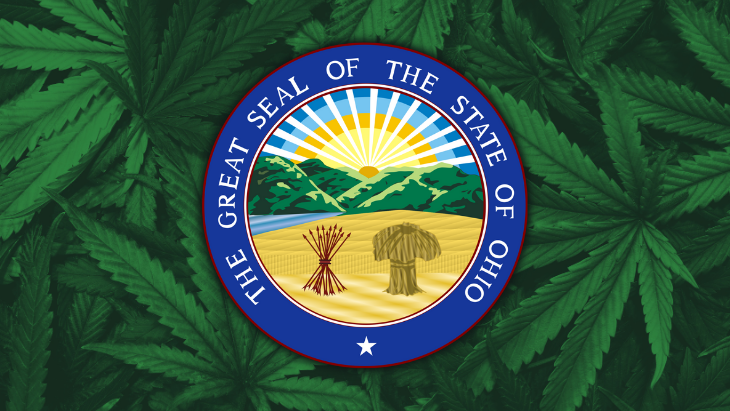
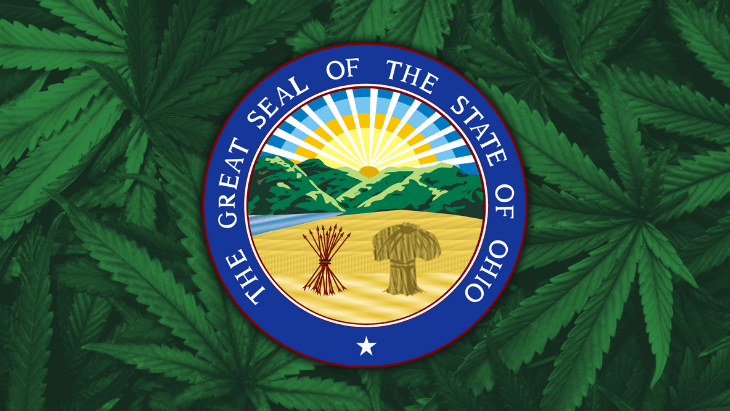
Ohio Senators gave final approval today to legislation (SB 56) significantly amending the state’s voter-approved adult-use legalization law. The measure now goes to Republican Gov. Mike DeWine, who is expected to sign it into law.
The Republican-spearheaded bill amends existing law in several ways. It criminalizes the possession of marijuana products obtained from out-of-state, including products legally purchased at licensed dispensaries in neighboring jurisdictions. No other legalization state imposes such restrictions.
It also repeals provisions that currently protect adult-use consumers from facing either workplace or professional disciplinary action, as well as other forms of discrimination based solely upon their private marijuana use (such as the denial of parental rights or certain hospital procedures, such as organ transplants). It imposes new arbitrary limits on the percentages of THC permitted in adult-use and medical cannabis concentrates and it caps the total number of retail licenses permitted statewide. It also imposes new criminal sanctions upon those who either possess or transport certain cannabis products if they are not in their original, unopened packaging, among other restrictions.
NORML lobbied intently against lawmakers’ efforts to roll back the law, which was approved in 2023 by 57 percent of voters. In an op-ed in The Columbus Dispatch, NORML’s Deputy Director Paul Armentano and Political Director Morgan Fox said: “Legislators do not have the right to play Monday morning quarterback simply because most Ohioans voted in a way they disapprove.” NORML’s action alert opposing SB 56 was shared with lawmakers over 24,000 times. It states: “This bill is a slap in the face to the millions of Ohioans who voted in favor of Issue 2. Once again, politicians are arrogantly trying to claim that the public didn’t know what they were voting for.”
Ohio Democratic Senator Bill DeMora, who worked closely with advocates in opposition to many of the new restrictions imposed in the bill, asked his colleagues ahead of the Senate vote, “Can anybody in this room tell me how this is respecting the will of the voters?” He later said, “This body has done everything in its power to give Ohio voters the finger.”
Other provisions in the bill restrict the the retail sale of certain hemp-derived products solely to state-licensed dispensaries. That restriction is set to take effect 90 days after the bill is signed into law. Statewide restrictions on the sale of certain hemp-infused beverages take effect next November.
NORML’s Deputy Director said that the GOP-led actions in Ohio are part of a growing and disturbing trend. In recent years, lawmakers in Republican-led states have become increasingly hostile to voter-approved marijuana laws, despite their bipartisan public support. For instance, lawmakers in Mississippi and South Dakota successfully sued to nullify election results in those states legalizing cannabis. In Texas, Republican Attorney General Ken Paxton sued several cities to overturn voter-initiated marijuana depenalization laws. In Nebraska, lawmakers and regulators have largely gutted the state’s voter-approved medical cannabis access law.
“In a healthy democracy, those with competing visions on public policy vie for voters’ support and abide by their voting decisions. However, it is becoming clear that those who oppose marijuana policy reform would rather take voters out of the equation altogether,” Armentano said. “Whether or not one personally supports or opposes cannabis legalization, these undemocratic tactics ought to cause of deep concern.”
Separate language in the legislation create a pathway for those seeking to expunge past marijuana-related convictions, clarifies that adults can legally consume cannabis on their private property (rather than solely inside their own private residence), and redirects a portion of tax revenues from marijuana sales to individual municipalities that license cannabis retailers.
Read the full text of Senate Bill 56.
Related
Medical Disclaimer:
The information provided in these blog posts is intended for general informational and educational purposes only. It is not a substitute for professional medical advice, diagnosis, or treatment. Always seek the advice of your physician or other qualified healthcare provider with any questions you may have regarding a medical condition. The use of any information provided in these blog posts is solely at your own risk. The authors and the website do not recommend or endorse any specific products, treatments, or procedures mentioned. Reliance on any information in these blog posts is solely at your own discretion.