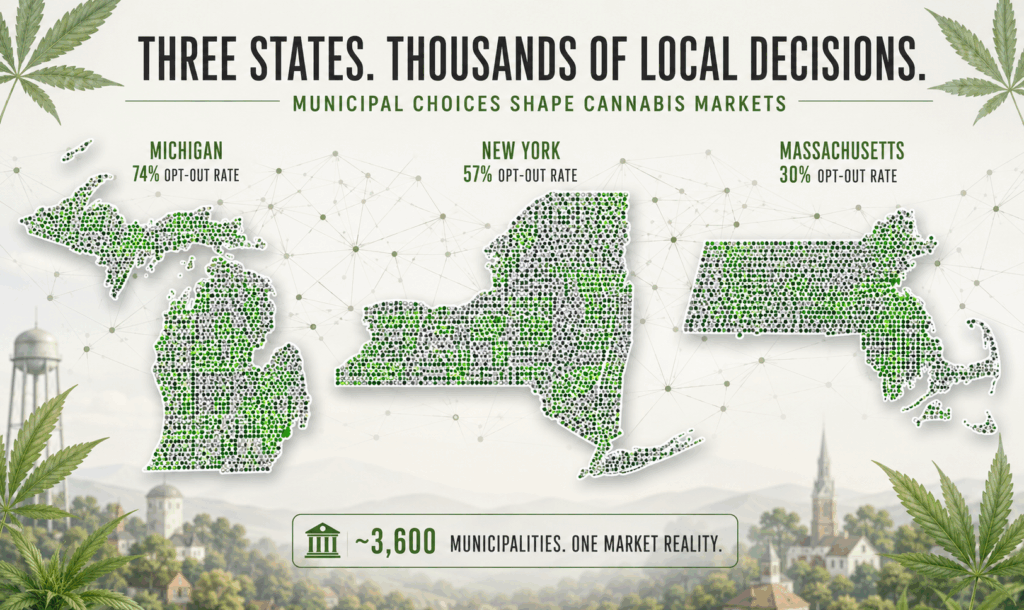
In New York, 57% of municipalities have opted out of adult-use cannabis sales. In Massachusetts, 30%. In Michigan, 74%. These aren’t state policies — all three states legalized statewide and left the ban decision to local government. That’s the point these numbers keep missing: the action isn’t in the state law, it’s in roughly 3,600 separate municipal votes across three states, and the state-level opt-out rate flattens that local decision-making into a single misleading number. Michigan has the highest opt-out rate of the three and is one of the strongest per-capita cannabis markets in the country.
What ties the three states together isn’t ideology — it’s geography and local government structure. In New York, opt-out status splits along regional and jurisdictional lines: Long Island opted out at 86%, the Mohawk Valley at just 30%, and villages opted out at a higher rate than towns, which opted out at a higher rate than cities. Massachusetts shows the same pattern from a different angle: its 30% municipal opt-out rate tracks almost exactly with the 29.5% of the state’s population those towns represent. We even checked New York’s opt-out map against 2024 presidential results and found no measurable correlation — confirming these are land-use decisions being made town by town, not a partisan story playing out at the ballot box.
What the ban rate obscures is who opted in. Michigan is the clearest case: every municipality with more than 50,000 residents allows adult-use retail. The 26% of municipalities that opted in cover a share of the state’s population wildly out of proportion to their count. A 74% opt-out rate sounds like a closed market. It isn’t one.
The sharper variable — and the one with real operator relevance — is delivery. All three states treat it differently, and that difference decides whether an “opted-out” town is actually inaccessible:
| State | Municipal opt-out rate | Delivery to opted-out towns |
| Michigan | 74% | Statewide mandate — no municipal override |
| New York | 57% | No opt-out mechanism exists for delivery |
| Massachusetts | 30% | Selectively blockable — 13 towns hold a CCC delivery waiver, capped and renewable only at the commission’s discretion |
Michigan’s local opt-outs are the loudest on paper and the leakiest in practice. Massachusetts is the opposite: a smaller opt-out rate, but the only one of the three where the state built a legal path for towns to close the delivery loophole too.
Timing and money explain why these numbers move. Michigan’s opt-outs have declined steadily, pulled by the state’s 15% excise revenue-share to host municipalities — towns that said no before the market existed are now watching neighbors collect tax dollars. New York has a comparable structure (75% of local excise tax stays local) but hasn’t seen the same drift, largely because its municipalities decided later, with more market data already in hand, making the initial decision harder to reverse.
The practical implication for anyone sizing a new-legal-state market: don’t model off the state-level opt-out percentage. Model at the municipal level, weight by population and delivery access rather than raw jurisdiction counts, and watch the revenue-sharing structure — it’s the best available predictor of which “no” votes eventually flip to “yes.”
Read more about these states at Emerald Intel – Ed Keating’s MarketPulse Blog:
Michigan: The State That Banned Its Way to a Booming Market
New York: New York’s Cannabis Opt-Out Map: Why It Has Nothing to Do With Politics
Minnesota: Massachusetts Has Created a New Kind of Cannabis Opt-Out

Medical Disclaimer:
The information provided in these blog posts is intended for general informational and educational purposes only. It is not a substitute for professional medical advice, diagnosis, or treatment. Always seek the advice of your physician or other qualified healthcare provider with any questions you may have regarding a medical condition. The use of any information provided in these blog posts is solely at your own risk. The authors and the website do not recommend or endorse any specific products, treatments, or procedures mentioned. Reliance on any information in these blog posts is solely at your own discretion.