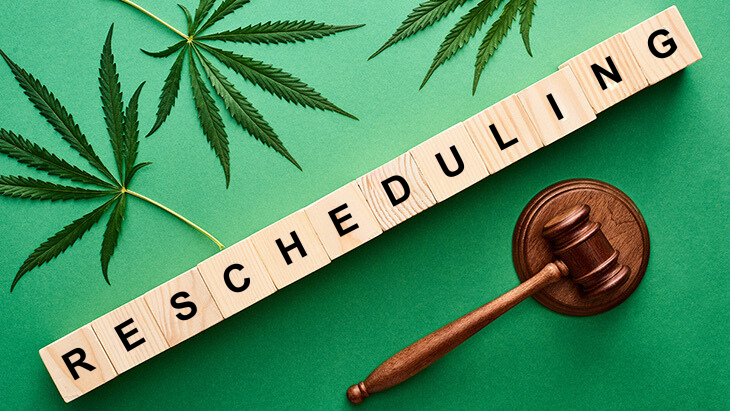
The National Organization for the Reform of Marijuana Laws (NORML) has filed a Notice of Intention to Participate in the Drug Enforcement Administration’s upcoming administrative hearing concerning the proposed rescheduling of botanical cannabis.
The hearing, scheduled to begin June 29, 2026, will consider whether marijuana should be transferred from Schedule I to Schedule III under the Controlled Substances Act as recommended in 2023 by the US Department of Health and Human Services.
NORML is seeking formal participant status as an “interested person” in the proceeding. In its filing, NORML argues that the hearing record will be incomplete unless it includes the perspective of adult cannabis consumers — the constituency NORML has represented for more than fifty years.
“Marijuana cannot lawfully remain in Schedule I,” said Joseph A. Bondy, Chair of NORML’s Board of Directors and counsel to NORML. “But Schedule III is not the end of the road. It is, at most, an interim correction. It does not resolve the federal government’s continued failure to recognize adult cannabis consumers who are acting lawfully under state law.”
NORML’s filing emphasizes that the organization does not oppose removing marijuana from Schedule I. But it does not concede that Schedule III is the proper final federal treatment for cannabis.
Instead, NORML continues to support descheduling — removing marijuana from the CSA schedules altogether — and replacing prohibition with a cannabis-specific federal regulatory framework focused on public health, consumer safety, product testing, truthful labeling, youth prevention, responsible commercial conduct, and illicit-market displacement.
The filing states that Schedule III remains a medicalized controlled-substance framework. While it may create or expand lawful pathways for FDA-approved products, research, and certain medical marijuana-related activities, it does not coherently account for the tens of millions of adults who consume cannabis under state adult-use laws without claiming to be patients, seeking physician supervision, or asserting medical necessity.
“Adult cannabis consumers do not become patients because federal law lacks a better category for them,” Bondy said. “They are not abusing medicine. They are participating in state-regulated adult-use systems enacted by voters and legislatures.”
NORML’s filing argues that federal scheduling directly affects consumers’ legal status, their access to tested and labeled products, exposure to collateral consequences, and their ability to participate safely in regulated state markets. It further argues that a Schedule III rule, if treated as final, would continue to leave adult-use consumers federally exposed while medicalizing lawful cannabis use.
NORML also seeks to present testimony from founder and Legal Counsel R. Keith Stroup, Deputy Director Paul Armentano, and a witness with direct expertise concerning adult-use cannabis consumers and state-regulated adult-use systems.
The filing also addresses treaty obligations, consumer safety, illicit-market displacement, criminal-justice consequences, and the need for a complete, balanced, and non-duplicative hearing record.
“NORML is not appearing as an industry-tax-relief organization, and it is not appearing as a medical-only advocacy group,” Bondy said. “NORML is appearing because cannabis consumers are directly affected by federal scheduling, and no other likely participant represents them as consumers.”
NORML maintains that marijuana should be removed from Schedule I immediately and ultimately descheduled.
“The federal government has acknowledged that Schedule I is untenable,” Bondy said. “But it has also acknowledged that marijuana remains illegal outside the medical and research channels opened by Schedule III. That unresolved gap is exactly where NORML’s members live. The hearing record will be incomplete without NORML’s inclusion.”
This is the second time that hearings before DEA have been scheduled as part of the ongoing administrative petition process, which was initiated by the Biden administration on October 2, 2022. Prior hearings, scheduled for last year, failed to take place following the issuance of an interlocutory appeal. NORML filed to participate in those hearings but was not among the parties selected.
In April, the Justice Department terminated those hearings and called for new proceedings. At that time, the Department and the DEA ordered that state-authorized medical cannabis products be reclassified under federal law from Schedule I to Schedule III. The purpose of the new hearings is to consider “factual evidence and expert opinion” regarding the reclassification of all marijuana products, not just those authorized for medical use.
All filings from those wishing to participate in the hearing will be reviewed by the US Drug Enforcement Administration. It remains unknown how many applicants will be chosen.
Related
Medical Disclaimer:
The information provided in these blog posts is intended for general informational and educational purposes only. It is not a substitute for professional medical advice, diagnosis, or treatment. Always seek the advice of your physician or other qualified healthcare provider with any questions you may have regarding a medical condition. The use of any information provided in these blog posts is solely at your own risk. The authors and the website do not recommend or endorse any specific products, treatments, or procedures mentioned. Reliance on any information in these blog posts is solely at your own discretion.